
What is Process Optimisation and Why Your Business Can’t Afford to Ignore It
Modern businesses can’t afford inefficiency—not just because of rising costs, but because the future is being built on intelligent technology. And AI won’t work in disorganised, outdated systems or data. That’s where process optimisation becomes more than an option—it becomes a prerequisite. Good processes result in good data.
What is Process Optimisation?
Process optimisation is the strategic improvement of business operations—streamlining workflows, eliminating waste, and aligning performance with business goals. It’s about:
- Doing things smarter, not just faster.
- Improving consistency and quality across every function.
- Reducing friction that slows teams down or frustrates customers.
Imagine every workflow in your business—from hiring to customer support—as a machine. When those machines are rusty, clunky, or misaligned, they slow everything down. Optimisation is how we tune the engine.
Why Process Optimisation Matters – Especially Now
- Boosts Efficiency & Productivity
Get more done with fewer resources by eliminating bottlenecks and redundant steps. - Improves Quality & Consistency
Streamlined processes mean fewer mistakes, which boosts trust and brand reliability. - Enhances Customer Experience
Faster, smoother services lead to more satisfied and loyal customers. - Increases Employee Engagement
Clear and logical workflows free teams from frustration and burnout. - Enables Scalability
Replicable, efficient processes allow you to grow with stability. - Reduces Operational Costs
From unnecessary licenses to manual errors—cut hidden waste across the board.
The Hidden Cost of Unoptimised Processes
“We’ve seen organisations with brilliant ideas and great people struggle—not because of lack of innovation, but because their internal processes couldn’t keep up.”
— Garry Green, Managing Director, Quanton
When business processes go unchecked, they cause:
- Stagnant productivity
- Escalating costs
- Quality issues
- Customer dissatisfaction
- Burnout and disengagement
- Missed opportunities for growth
- And most critically—they block you from adopting AI
Here’s the Reality: You Can’t Implement AI on a Broken Foundation
AI thrives on structure—clean data, standardised processes, and clear workflows. Without these, AI will amplify the chaos, not solve it.
That’s why process optimisation isn’t just about cost savings—it’s about preparing your organisation for AI.
Introducing Quanton’s QLOAD Framework for AI Readiness
We don’t just talk about transformation—we implement it through our proven framework:
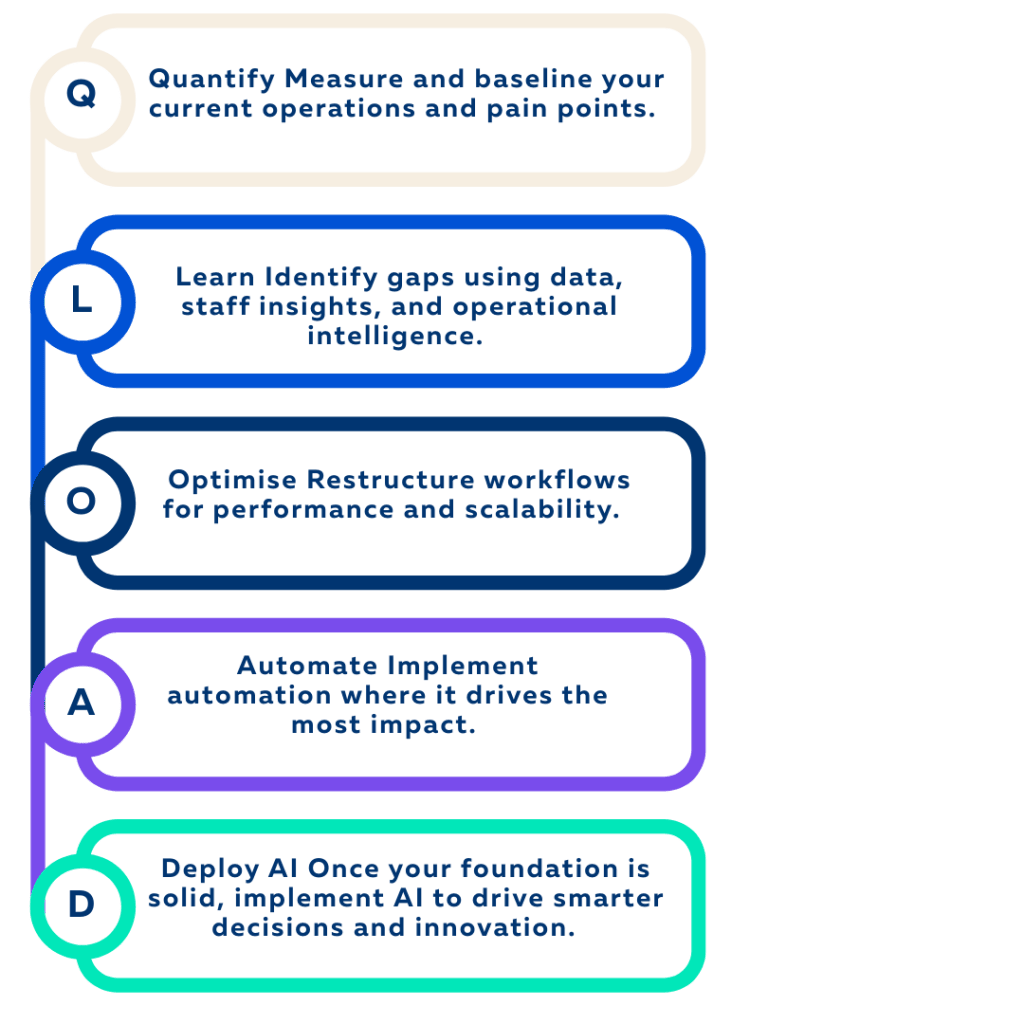
“AI cannot succeed in a disorganised environment… The QLOAD framework lays the groundwork for digital maturity.”
— Ursula Riemer, Strategic Engagement Director, Quanton
The Time to Optimise is Now
“The most future-ready companies are the ones that have mastered the basics—optimised processes, trusted data, and a culture of continuous improvement.”
— Strategist, Quanton
AI success is not about chasing trends. It’s about preparation. And that starts with getting your house in order.
Take the First Step
Want to know how ready your business really is for AI?
Let Quanton help assess your current state, uncover inefficiencies, and guide you toward future-ready operations with our QLOAD framework.
Process optimisation is the first step to AI transformation. Let’s start there.